Photo Gallery
Hurricanes
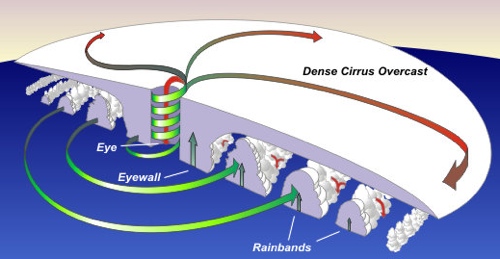
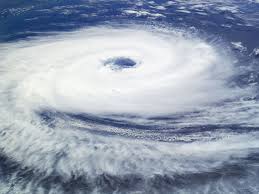
A Hurricane is a type of tropical cyclone or severe tropical storm that forms in the southern Atlantic Ocean, Caribbean Sea, Gulf of Mexico, and in the eastern Pacific Ocean. A typical cyclone is accompanied by thunderstorms, and in the Northern Hemisphere, a counterclockwise circulation of winds near the earth’s surface.
- What causes Hurricanes?
The two essential ingredients in every hurricane are warm water and moist warm air. That’s why hurricanes begin in the tropics.
Most Atlantic hurricanes start to take shape when thunderstorms along the west coast of Africa drift out over warm ocean waters that are at least 80 degrees Fahrenheit (27 degrees Celsius), where they encounter converging winds from around the equator.
Warm Air, Warm Water Make Conditions Right for Hurricanes
Hurricanes start when warm, moist air from the ocean surface begins to rise rapidly, where it encounters cooler air that causes the warm water vapor to condense and to form storm clouds and drops of rain. The condensation also releases latent heat, which warms the cool air above, causing it to rise and make way for more warm humid air from the ocean below.
As this cycle continues, more warm moist air is drawn into the developing storm and more heat is transferred from the surface of the ocean to the atmosphere. This continuing heat exchange creates a wind pattern that spirals around a relatively calm center, or eye, like water swirling down a drain.
Converging Winds Create Hurricanes
Converging winds near the surface of the water collide, pushing more water vapor upward, increasing the circulation of warm air, and accelerating the speed of the wind. At the same time, strong winds blowing steadily at higher altitudes pull the rising warm air away from the storm’s center and send it swirling into the hurricane’s classic cyclone pattern.
- Prediction of Hurricanes
The 2013 Atlantic hurricane season outlook is an official product of the National Oceanic and Atmospheric Administration (NOAA) Climate Prediction Center (CPC). The outlook is produced in collaboration with hurricane experts from the NOAA’s National Hurricane Center (NHC) and Hurricane Research Division (HRD). The Atlantic hurricane region includes the North Atlantic Ocean, Caribbean Sea, and Gulf of Mexico.
Sources of uncertainty in this seasonal outlook
1. Predicting El Niño and La Niña (also called the El Niño-Southern Oscillation, or ENSO) events and their impacts is an ongoing scientific challenge facing climate scientists today.
2. Many combinations of named storms and hurricanes can occur for the same general set of climate conditions. For example, one cannot know with certainty in a given year whether the climate signals will be associated with more longer-lived but weaker storms, or with fewer shorter-lived but stronger storms.
3. Weather patterns that are unpredictable on seasonal time scales can sometimes develop and last for weeks or months, possibly affecting seasonal hurricane activity.
Hurricane Preparedness
Hurricane disasters can occur whether a season is active or relatively quiet. It only takes one hurricane (or tropical storm) to cause a disaster. Residents, businesses, and government agencies of coastal and near-coastal regions are urged to prepare for every hurricane season regardless of this, or any other, seasonal outlook. NOAA, the Federal Emergency Management Agency (FEMA), the National Hurricane Center (NHC), the Small Business Administration, and the American Red Cross all provide important hurricane preparedness information on their web sites.
- Create an evacuation plan. Map the safest areas and routes through which to evacuate your home. Identify multiple emergency transit routes in all directions and a primary and a secondary meeting location. Know where your nearest evacuation shelters are located.
- Prepare an easily transportable emergency kit.
- Identify an out-of-area contact. Designate a friend or a family member in another state who can act as a communication traffic manager, and make sure that person has your updated contact list (children's schools, doctors' offices, employer, etc.).
- Educate your family. Make sure that everyone in your family can identify hurricane warnings and understands what to do when warnings are given.
- Ensure that drinkable water is available. Fill up bathtubs and sinks.
- Fill up the gas tank in case you need to evacuate.
- Know where and how family pets will be cared for.
- Make your home hurricane-ready. Install hurricane shutters, prune your trees and secure loose roof shingles or tiles.
- Secure, close and lock all doors and windows. Close all curtains and drapes for protection against shattered glass.
- Protect documentation. Make copies of all important documents (passport, driver's license, birth certificate, financial documentation, auto registration and license, property deeds, will, etc.) and keep copies with an out-of-area contact.
- Turn off all electronics. Make sure that circuit breakers are turned off and all home electronics are unplugged to prevent damage from power surges.
